What a guard is
A guard is any position where you are on the bottom with your legs between you and the other person. This tutorial explains the main guards, passing, and how to keep your guard.
Legs between you
In guard, you use your legs, and usually a grip, to stop the top player getting past your legs.
Loading 3D view
Your legs are between you and your partner, so they cannot reach your chest. Guard in the library ›
Past your legs, the top player can reach a pin. A pin is a position where they hold you down: side control, north-south, knee on belly or mount.
A sweep means you tip them over and come up on top. The top player's job is to pass. The bottom player's job is to keep the guard, sweep or submit.
Closed, open and half guard
| Guard | What it is | What it gives you |
|---|---|---|
| Closed guard | Legs around their waist, ankles locked | Control of posture, and they cannot walk away |
| Open guard | Ankles not locked; feet, knees and grips control distance | Lots of movement, if you stay connected |
| Half guard | One of their legs trapped between yours | They are halfway past, not past yet |
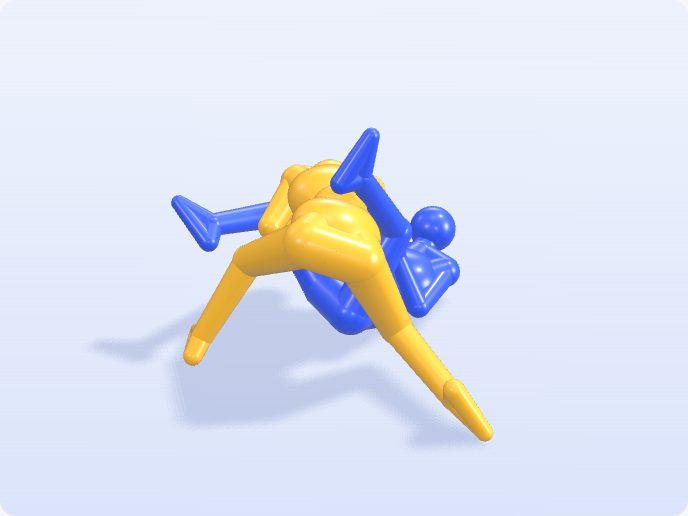
 Open GuardOpen guard: your ankles are not locked, and your feet and knees keep the distance.
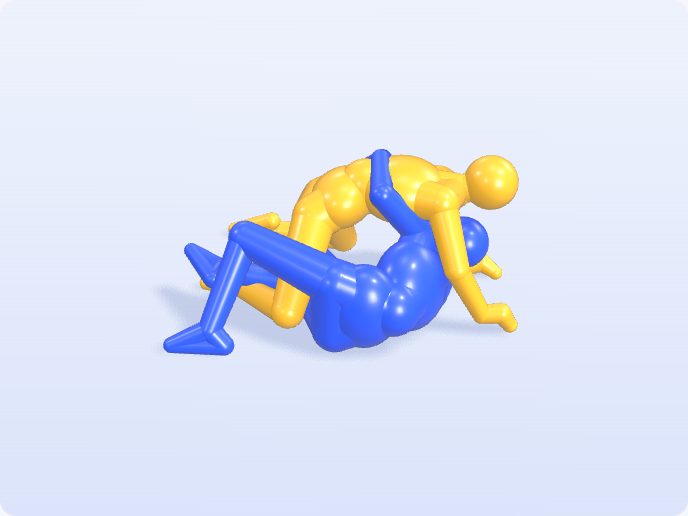
 Half GuardHalf guard: one of their legs is trapped between your legs.
Butterfly guard is an open guard: your feet hook inside their thighs. Knee shield is a half guard: your top knee crosses their hips as a frame.
What passing means
A guard pass means getting past both legs and holding a pin. Under IBJJF rules it scores 3 points when held for 3 seconds.
- A closed guard must be opened first. The top player stands up or works the ankles open.
- Passes go around the legs or through the legs.
- Both kinds need control of the hips. Pinned hips mean the legs cannot follow.
Your partner passes to side control. Before 3 seconds go by, you shrimp and bring your knee back in. The guard is back, and they score nothing.
How a guard is lost
- Feet off the hips, legs straight, no grips: no connection.
- Opening your closed guard for no reason.
- Reaching with your arms instead of turning your hips.
- Letting both hips get pinned.
- Turning away onto your belly. That gives your back.
You play knee shield half guard. Your shield knee drops. Your partner's chest comes down and pins your hips. Now the pass is coming, slowly.
Keep it or get it back
Guard retention means keeping your legs in the way while they try to pass. Guard recovery means getting your legs back after they passed.
Loading 3D view
When their pass is nearly done, frame, shrimp and bring your knee back in. Guard Retention and Recovery in the library ›
- Frame on their neck and hip.
- Shrimp your hips away.
- Bring your knee in between you.
- Get your legs back in front of them: guard.
The shrimp and the frame are in Movements you need.
You play open guard with your feet on your partner's hips. They knock one foot off and step to the side. What keeps your guard?
Train it on the Path
Reading is the first step. The What a guard is unit has 5 short lessons: you see a position and pick the best move.
The Path goes in order: start free from lesson one and you reach What a guard is on the way. With Rolla Plus you can jump straight here.